
A national warning
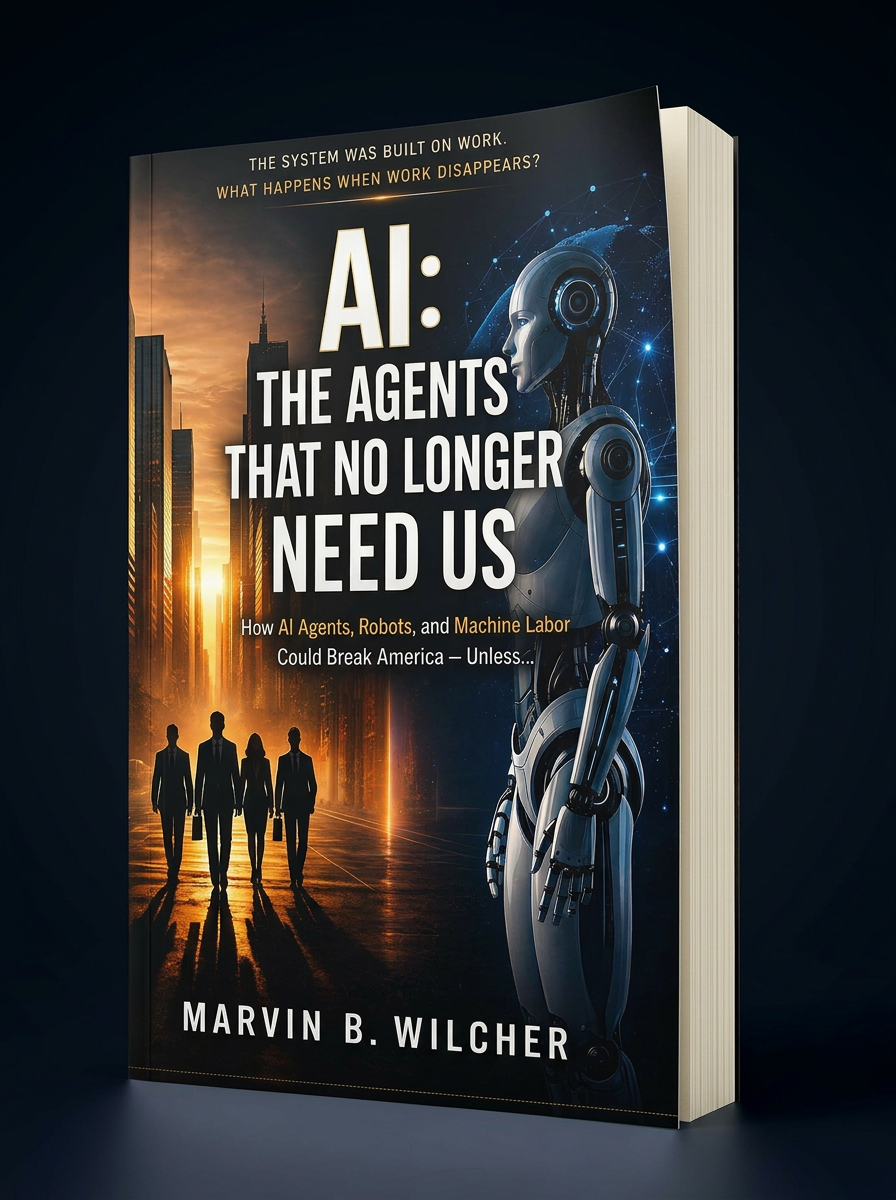
AI: The Agents That No Longer Need Us
by Marvin B. Wilcher
How AI Agents, Robots, and Machine Labor Could Break America — Unless…
AI may not break America because it becomes evil. It may break America because it becomes useful enough to replace the labor that funds the country.
If machines take the work, then machines must pay the cost.
Available now
AI: The Agents That No Longer Need Us is available now in paperback and Kindle eBook formats on Amazon.
- Paperback
- $19.99
- Kindle eBook
- $9.99
The central argument
Autonomous machines can create value without needing workers.
America was built around people working. Work created wages. Wages funded households. Payrolls funded public systems. Taxes funded the country. Autonomous AI agents, robotics, and machine labor can now keep production moving while reducing the need for human workers. The work remains. The wage disappears. The tax base weakens. That is the collapse mechanism this book documents.
Old Labor System
Machine Economy — Without Reform
Machine Economy — With Labor Replacement Tax
Why it matters
The consequences reach past the workplace.
Employment displacement
Machine labor absorbs tasks across warehousing, service, administration, logistics, and knowledge work.
Payroll and income-tax erosion
Most public revenue is tied to wages. Fewer wages means a shrinking tax base, regardless of how much output rises.
Government funding pressure
Social insurance, healthcare, infrastructure, and education were financed by payroll-linked receipts.
Economic inequality
Machine-driven gains concentrate with the owners of the machines rather than the workers they replace.
Social instability
Households absorb the shock first: caregiving, housing, debt, and the loss of a working identity.
Political instability
A country that cannot fund its obligations cannot keep its political consensus intact.
What readers will discover
Four turns the country can't ignore.
The Labor System
How work funds America — and why payroll sits underneath nearly every public system.
The Machine Turn
How AI agents and robots replace labor while output keeps climbing.
The Mathematical Wall
Why the numbers stop working once the wage base contracts.
The Labor Replacement Tax
How machine-driven value can carry the civic obligation labor once carried.
Who should read it
Written for people who decide what happens next.
Tax and economic policy readers, legislators and staff, business owners and operators, investors, technology leaders deploying autonomous systems, journalists covering AI and labor, and any reader who wants the structural argument rather than the headline.
The Labor Replacement Tax
If machines inherit the work, machine value must inherit the obligation.
Not a punishment on technology. A structural answer to a structural problem. When machines replace taxable human labor, machine-driven value must begin carrying part of the civic burden that labor once carried — so public systems remain solvent while innovation continues.
The policy work also lives at LaborReplacementTax.com.
Two futures
Same machines. Different structure.
Breakdown future
Machines work beautifully while people lose their place.
Production rises. Wages fall. The tax base hollows. Public systems fracture.
Adaptive future
Machine value helps fund care, stability, transition, and public life.
The same machines exist — but the civic structure follows the work.
About the author
Marvin B. Wilcher
Marvin B. Wilcher brings more than 45 years of entrepreneurial and business experience, including the acquisition of more than 27 companies across operations, strategy, technology, manufacturing, finance, and media. He writes at the intersection of artificial intelligence, public finance, and the labor systems that hold societies together.
Media and resources
Press materials, questions, and free downloads.
Get the book
AI: The Agents That No Longer Need Us
The machine economy is already arriving. The question is whether it becomes extraction or survival architecture. Read the book. Understand the warning. Join the debate before the Mathematical Wall becomes impossible to ignore.
Available now
- Paperback
- $19.99
- Kindle eBook
- $9.99